
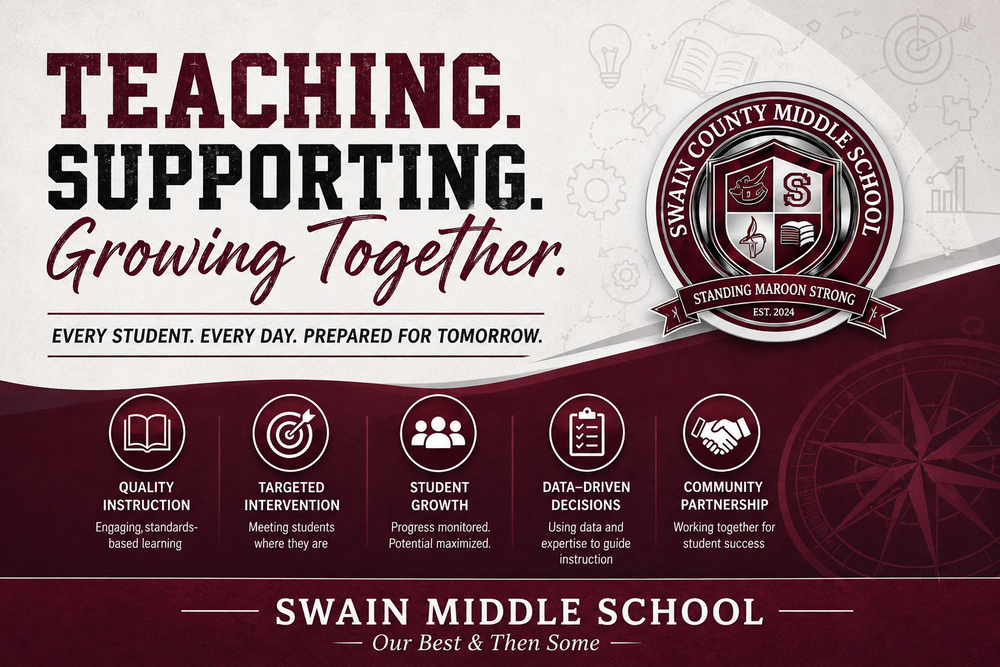
How We Teach and Support Every Student at Swain Middle School
At Swain Middle School, we believe every student can learn, grow, and succeed when provided with high-quality instruction, meaningful support, and opportunities to be challenged. Our instructional framework is built on research-based practices from Dr. Robert Marzano's The New Art and Science of Teaching and is designed to ensure that every classroom provides engaging, rigorous, and student-centered learning experiences.
A Consistent Approach to Learning
Students at Swain Middle School experience a consistent instructional model across all grade levels and subject areas. This consistency helps students understand expectations, build confidence, and focus on learning.
Activate: Preparing Students for Learning
Every lesson begins with an opportunity to prepare students for success. Teachers:
Review previous learning and connect it to new concepts.
Activate prior knowledge and real-world experiences.
Clearly communicate learning targets and lesson goals.
Establish success criteria so students understand expectations.
This phase helps students enter the learning process focused, engaged, and ready to succeed.
Connect: Engaging in Meaningful Learning
The core of instruction occurs during the learning process. Teachers utilize the gradual release model:
I Do – The teacher models and demonstrates new learning.
We Do – Students and teachers work together through guided practice.
You Do – Students independently apply their learning.
During this phase, students engage in active learning through discussion, collaboration, problem-solving, and critical thinking. Teachers use questioning strategies, provide meaningful learning tasks, and offer support as students build understanding and develop new skills.
Affirm: Reflecting and Applying Learning
Every lesson concludes with opportunities for students to reflect on their learning and demonstrate understanding. Teachers provide feedback and help students:
Monitor their own progress.
Demonstrate mastery of learning targets.
Apply learning in new situations.
Identify next steps for continued growth.
This reflection process strengthens learning and helps students leave class with a clear understanding of what they have learned.
Standards-Based Planning
All instruction begins with North Carolina academic standards. Teachers carefully design lessons and learning experiences that align with grade-level expectations and prepare students for future success.
Instructional planning includes:
Identifying priority standards and essential learning outcomes.
Developing clear learning targets and success criteria.
Incorporating academic vocabulary and literacy skills across content areas.
Differentiating instruction to meet diverse student needs.
Providing scaffolds and supports when necessary.
Designing engaging learning experiences that promote deep understanding.
Our goal is not simply to cover content but to ensure students master the knowledge and skills necessary for success in middle school, high school, and beyond.
Continuous Assessment and Feedback
Assessment is an ongoing part of the learning process at Swain Middle School. Teachers regularly gather information about student understanding to guide instruction and provide timely support.
Methods used to monitor progress include:
Classroom discussions
Exit tickets
Formative assessments
Quizzes and tests
Student work samples
Performance tasks
Benchmark assessments
These frequent checks for understanding allow teachers to celebrate growth, address misconceptions, and adjust instruction to meet student needs.
Measuring Learning Through Proficiency Scales
At Swain Middle School, teachers use proficiency scales developed through the research and resources of Dr. Robert Marzano and The New Art and Science of Teaching. Proficiency scales provide a clear roadmap for learning by identifying what students should know and be able to do as they progress toward mastery of academic standards.
Rather than focusing solely on grades, proficiency scales help students, teachers, and families understand where a student is in the learning process and what steps are needed to continue growing.
What Is a Proficiency Scale?
A proficiency scale breaks a learning goal into progressively more complex levels of understanding. Each level describes specific knowledge and skills students are expected to demonstrate.
Proficiency scales help:
Clarify learning expectations.
Define what mastery looks like.
Guide instruction and assessment.
Provide meaningful feedback to students.
Track growth over time.
Support goal setting and self-reflection.
Understanding the Scale
While proficiency scales may vary slightly based on the standard being taught, they generally follow a four-level structure:
Level 4.0 – Advanced Application
Students can apply their learning in new and complex situations, make connections across concepts, and demonstrate understanding beyond grade-level expectations.
Level 3.0 – Proficient
Students demonstrate mastery of the grade-level standard and can independently perform the skills and concepts identified as the learning goal.
Level 2.0 – Developing
Students demonstrate partial understanding of the standard and can perform foundational skills with support. Additional practice and instruction may be needed to reach proficiency.
Level 1.0 – Beginning
Students are beginning to develop the foundational knowledge and skills necessary for the learning goal and require significant support and guidance.
How Teachers Use Proficiency Scales
Teachers use proficiency scales throughout the instructional process to:
Design lessons aligned to learning targets.
Develop assessments that measure student understanding.
Monitor student progress toward mastery.
Provide specific and actionable feedback.
Differentiate instruction based on student needs.
Help students set goals and monitor their own learning.
Because proficiency scales clearly define expectations, students understand what they are learning, how their performance is measured, and what they need to do to improve.
Supporting Growth for Every Student
Proficiency scales align closely with our commitment to growth and continuous improvement. They allow teachers to identify strengths, address learning gaps, and provide targeted support while recognizing student progress along the way.
By using proficiency scales as part of our instructional framework, Swain Middle School ensures that learning remains focused on mastery, growth, and helping every student reach their full potential.
Supporting Student Growth Through Targeted Needs Time (TNT)
Every student deserves access to the support and opportunities necessary to achieve academic growth. To meet this commitment, Swain Middle School provides Targeted Needs Time (TNT), a dedicated period focused on intervention, skill development, enrichment, and personalized learning.
What is TNT?
Targeted Needs Time is a structured part of the school day designed to provide students with additional academic support and opportunities for growth. TNT allows teachers to respond to student needs in a timely and purposeful manner by providing focused instruction beyond the regular classroom setting.
TNT is designed to:
Strengthen foundational skills.
Reinforce grade-level standards.
Address learning gaps.
Extend and enrich student learning.
Provide additional opportunities for practice and feedback.
Promote student confidence and academic success.
Teachers use multiple sources of information to determine how best to support students during TNT, including:
State assessment results
EVAAS growth and proficiency projections
i-Ready diagnostic data
Classroom assessments and grades
Teacher observations
Student performance trends
Behavioral and social-emotional considerations
No single data point determines the support a student receives. Teachers collaborate regularly to review student progress and make informed decisions about instructional needs.
Flexible and Responsive Support
Student needs change over time, and TNT is designed to be flexible. Teachers continuously monitor progress and adjust instruction based on student growth and performance. As students demonstrate improvement or require additional support, their learning experiences during TNT may change to ensure they continue receiving the appropriate level of challenge and assistance.
This responsive approach ensures that support is personalized, targeted, and focused on helping every student make meaningful academic progress.
A Partnership for Student Success
Student achievement is strongest when schools and families work together. At Swain Middle School, we are committed to:
Providing high-quality instruction every day.
Maintaining high expectations for all students.
Monitoring student progress closely.
Providing timely support and intervention.
Offering opportunities for enrichment and growth.
Building strong relationships with students and families.
Creating a safe, supportive, and engaging learning environment.
Through consistent instruction, targeted support, and a commitment to continuous improvement, we ensure every student has the opportunity to reach their full potential.
At Swain Middle School, our mission is simple: provide every student with what they need to learn, grow, and succeed.